Showing posts with label academic writing. Show all posts

Wednesday, January 04, 2023

Tools for Academic Writing in 2023

When writing a scientific paper, I use several tools below to boost and speed up my writing process. Hence, I only need two weeks to a month to complete the first version of my manuscript (after the experiment has been conducted). Two tools are paid: Copilot and Grammarly. Before going down to the list below, you may also be interested in my resources for academic writing - word concordance [1]. For last year's tool (2022), specializing on both research and paper writing instead of paper writing only, you can check it here [2].

  1. Mendeley (the old desktop version, not the new reference manager, to create a BIB file automatically)
  2. Grammarly (vscode plugin)
  3. Latex Workshop (vscode plugin)
  4. Copilot (vscode plugin)
  5. ChatGPT (to ask questions)
By using these tools, I DON'T need to:
  • Create bibliography manually
  • Sometimes, write all sentences in paragraphs since Copilot will do it.
  • Check the grammar manually.
  • Create Table, Figure, and Equation manually in Latex (thanks to Latex Workshop).
Other tools (unexplored well, in progress for adaptation)
  1. https://www.explainpaper.com (tool to explain any hard-to-understand terms/sentences in a paper)
  2. https://elicit.org/ (like ChatGPT, but with reference)
  3. LTeX – LanguageTool grammar/spell checking (alternative to Grammarly, free)

Reference
[1] http://bagustris.blogspot.com/2020/07/resources-for-academic-writing-word.html
[2] https://bagustris.blogspot.com/2023/01/tools-i-used-for-accelerating-science.html

Friday, September 09, 2022

Installing TexLive 2022 on Ubuntu 22.04 under Multipass

Multipass is a game changer. It looks like a virtual environment for python or a virtual box for OS, but for Ubuntu instances only (the hosts can be Windows and MacOS). This short writing documented my effort to enable the installation of TexLive 2022 for adding IEEE header and footer for camera-ready APSIPA 2022.

Host environment

bagus@L140MU:~$ snap --version
snap    2.56.2
snapd   2.56.2
series  16
ubuntu  20.04
kernel  5.15.0-46-generic
bagus@L140MU:~$ multipass --version
multipass   1.10.1
multipassd  1.10.1

Steps

1. Install multipass (refer to this link for detail).
2. Create an instance with Jammy (Ubuntu 22.04)
multipass launch jammy --disk 10G 
Launched: famed-chaffinch

2. Login to Jammy's shell (change the name of instance)
 multipass shell famed-chaffinch
3. Update Jammy
 sudo apt update
4. Install texlive and required packages
sudo apt install texlive-base texlive-fonts-extra texlive-fonts-recommended texlive-publisher
5. Try on the desired latex template
$ wget https://www.apsipa2022.org/APSIPA_ASC_2022_Template.zip
$ sudo apt install unzip
$ unzip APSIPA_ASC_2022_Template.zip
$ cd APSIPA_ASC_2022_Template/Latex
$ pdflatex PaperSample_Guideline_tex.tex
...
Output written on PaperSample_Guideline_tex.pdf (3 pages, 126525 bytes).
Transcript written on PaperSample_Guideline_tex.log.
That's all. For 20.04, it will throw to an infinite recursion loop due to the lower fancy version. The only solution is to install newer Latex on Ubuntu 22.04 under multipass. For real cases, you may need to mount your local directory (which contains TEX files) to an instance with `multipass mount`.
$ multipass mount $HOME famed-chaffinch

Monday, August 01, 2022

Maksimal jumlah referensi self-citation

Best practice jumlah self-citation pada makalah akademik adalah 10% dari total jumlah referensi. Sumber lain membolehkan 7-20%  [1]. Untuk saya pribadi, jumlah maksimalnya adalah berdasarkan tabel dan rumus di bawah ini.

Number of references Max. self-citation
1-10 1
11-20 2
21-30 3
... ...
91-100 10

Contoh, jumlah referensi: 24, maksimal self-citation: 3.


Rumus

$$ n\_cite=10\% \times ceil(n\_ref/10) \times 10 $$

Dimana n_cite adalah jumlah maksimal self-citation and n_ref adalah jumlah referensi.


Kenapa self-citation?

Karena biasanya kita meneliti dan menulis makalah akademik tidak dari nol, tapi dari penelitian-penelitian kita sebelumnya. Disinilah self-citation masuk.

Alasan kedua adalah untuk mendongkrak h-indeks (Scopus, G-scholar, WOS) peneliti yang bersangkutan.


Referensi: 

[1] https://www.ncbi.nlm.nih.gov/pmc/articles/PMC3049640/#:~:text=Self%2Dcitation%20ranges%20from%207,with%20many%20authors%20%5B13%5D.

Tuesday, April 26, 2022

Writing for impact, not for impact factor

Nowadays, research is measured by publication. Publish or perish. The pressure for researchers to publish is now more than ever. As a result, there are tons of research publications. Most of them may be garbage; only a small portion has an impact. So, what is the impact in research?

Impact factor

At first, I thought that "writing for impact is writing for impact factor" (since "impact" is measured by "impact factor"). By this definition, the author will seek for writing to the Journal which has high impact factors due "impact" is defined by the calculation of impact factor. In fact the (impact factor calculation is based on citations and the number of publications)[https://en.wikipedia.org/wiki/Impact_factor]. Hence, writing for impact factor is no more than writing for citations. I changed my mind recently, writing for impact is not writing for impact factor. The impact is different with (calculation of) impact factor. Now, some journals and conferences requested this "social impact" as an additional section in the author's manuscript [1, 2]. It is good. By this method (requesting to show the impact of their research), the impact of research now is clearer than before.

Kinds of social impact

Now, when asked to write the social impact of my writing, I am thinking of what social impact will be in my manuscript. Reference [1] requested explicitly what is the definition of "positive impact" for authors. A positive impact could be one of the following (my own definition).

1. Readers change their perspective. For instance, the paper entitled "Toward a consensus on symbolic notation of harmonics, resonances, and formants in vocalization" proposed a new standard notation for fundamental frequency (in acoustics), i.e., by writing it as $f_o$ (ef-ow) instead of F0, $F_0$ or $f_0$ (ef-zero). This paper has a big social impact on the (acoustic) community.

2. Readers can learn. Many papers show their method clearly so the readers can learn and get the benefit from reading the paper. An instance is a paper entitled "CALFEM as a Tool for Teaching University Mechanics."

3. Readers can replicate. Open science is making a difference. Anyone can replicate the experiment of the authors. This kind of research is game-changing. Even big companies like Google, Microsoft, and Meta open their research publicly along with open repositories to replicate the research. Most of my research is also open science, one example is a paper entitled "Deep Multilayer Perceptrons for Dimensional Speech Emotion Recognition".

4. Readers can improve the result. One way to improve the current result is by explicitly proposing further directions. This statement usually is placed in the Conclusions or before this section.

5. A policy can be taken. This is the highest impact, a policy can be taken from a research result. For instance, to fight global warming (based on specific data), the government changes the policy to abandon the use of coal and move to nuclear energy. Or, based on the risk of nuclear energy, the government encourages the use of wind and solar energy.


Hope this opinion will change your minds; do not write for impact factor (only), but do write for real (social) impact.


Reference:

[1] https://s4sg-workshop.github.io/

[2] https://acii-conf.net/2022/authors/submission-guidelines/

Wednesday, April 06, 2022

New Paper: Survey on bimodal speech emotion recognition ...

Finally, the final version of my paper appeared in Elsevier. This is my second paper in Speech Communication Journal (currently it is Q1, IF: 2.0, CiteScore:4.8, h5-index: 28, google top 20). This one is open access in contrast to the previous subscription paper. Here is the link. For short descriptions, you can read through this passage.

https://doi.org/10.1016/j.specom.2022.03.002

Abstract

Speech emotion recognition (SER) is traditionally performed using merely acoustic information. Acoustic features, commonly are extracted per frame, are mapped into emotion labels using classifiers such as support vector machines for machine learning or multi-layer perceptron for deep learning. Previous research has shown that acoustic-only SER suffers from many issues, mostly on low performances. On the other hand, not only acoustic information can be extracted from speech but also linguistic information. The linguistic features can be extracted from the transcribed text by an automatic speech recognition system. The fusion of acoustic and linguistic information could improve the SER performance. This paper presents a survey of the works on bimodal emotion recognition fusing acoustic and linguistic information. Five components of bimodal SER are reviewed: emotion models, datasets, features, classifiers, and fusion methods. Some major findings, including state-of-the-art results and their methods from the commonly used datasets, are also presented to give insights for the current research and to surpass these results. Finally, this survey proposes the remaining issues in the bimodal SER research for future research directions.


Method

This is my first survey/review paper. I divided the contents into the building blocks of SER. First, I show the background of shifting from unimodal acoustic analysis to bimodal acoustic-linguistic information fusion. The rest is a comparison of more than a hundred papers. The most interesting part is that I summarized the comparison in several tables highlighting current state-of-the-art results (SOTA).

Result

The most important results are Table 3, Table 4, and Table 5. Here is a screenshot of Table 3 which list the current SOTA for the IEMOCAP dataset.
iemocap


Take home message

  1. There are several challenges listed in the paper
  2. Can we extract linguistic information without text? Yes, it can. Read here (actually it is included in the challenges part of my review paper, and someone already did it).

Citation

Don't forget to cite my paper as below if you get the benefit of reading that paper for your own manuscript.
Atmaja, B. T., Sasou, A., & Akagi, M. (2022). Survey on bimodal speech emotion recognition from acoustic and linguistic information fusion. Speech Communication, 140, 11–28. https://doi.org/10.1016/j.specom.2022.03.002

Monday, March 28, 2022

Tools I used for (accelerating) science and research 2022

I made seven publications this year (April 2021 - March 2022) and eight publications last year (April 2020 - March 2021). Here is the list of the tools (and their description) for accelerating my research.

The list is ordered based on its importance.

1. OS: Ubuntu (the most useful part: stfp inside nautilus)

2. vscode (both python and latex, also remote editing)

3. ssh with byoubu (open multiple sessions of the terminal in one instance)

4. Libreoffice (draw, calc, impress, writer)

5. Inkscape (for editing plots)

6. Simplenote (to make notes)

7. Grammarly (paid, mostly inside vscode)

8. Gnumeric (spreadsheet-like)

9. Insync (paid, to host one drive, google drive, dropbox, etc)

10. pdfcrop (to crop your image, automatically!!)

11. clipit (clipboard manager )

12. Mendeley (reference manager, automatic BIB file creation)


Tuesday, March 15, 2022

Permasalahan Ekuitas Jurnal Open Access

Jurnal dengan skema Open Access (OA) terlihat fair: jika anda (penulis) ingin tulisannya bebas diunduh (didownload), maka harus membayar article processing charge (APC). APC ini tidak murah, jurnal dimana saya mengirim tulisan saya, yakni Speech Communication, mematok USD 2390 untuk APC-nya. Daftar APC lengkap untuk jurnal Elsevier ada di sini. Jika tulisan kita diterima, maka kita bisa memilih subcription fee agar terhindar dari APC. Konsekuensinya, orang yang mau mengunduh tulisan kita harus membayar (melanggan) baik secara pribadi ataupun secara institusi. Catatan (baik) pentingnya, proses review tidak bergantung pada pilihan publikasi ini, baik open access atau subcription fee. Acceptance rate dari jurnal-jurnal Elsevier tetap kompetitif, sekitar 20-30% dari total 100% submisi.

Kembali kita tulis logika sederhananya.

Jika anda penulis ingin tulisan anda gratis diunduh, anda harus membayar APC. Jika tidak, maka pengunduh yang harus membayar biaya unduhannya.

Statement di atas terlihat logis, namun ada permasalahan mendasar pada logika di atas.

Permasalahan

Bagaimana dengan penulis yang tidak memiliki dana untuk membayar APC padahal open science / open research itu seharusnya tetap diberlakukan (wajib) bagi mereka? Disinilah ketidakadilan (inequity) itu nampak.

Saya pun belum menemukan solusi untuk hal ini; pun demikian ada rekomendasi dari ON-MERRIT yang bisa dibaca di sini. Ada jurnal open access di [1] yang bebas APC, namun (mungkin) reputasinya dipertanyakan. Penerbit tentunya tidak mau rugi, namun harus tetap profesional dalam mencari biaya operasional perusahaan mereka.

Note:

1. Ada jurnal open access yang bebas biaya APC,  daftarnya ada di URL ini.

Wednesday, January 19, 2022

Choosing Journals and Conferences for Publication: Google Top 20 (and h5-index > 30)

If you want to publish your academic paper in a conference or journal, you may be confused about to which conference or journal you should submit your papers to. This short article may help you. To be categorized as a "reputable journal", my institution required two indicators below.

  1. It appears in Google Top 20 (all categories, categories, and sub-categories)
  2. It has Google H5-index > 30
For the first reason, it makes sense. The top twenty are the top 20 journals and conferences (mixed) which have the highest h5-index. I don't know the reason for the second reason why my institution chooses 30 as the limit of h5-index for "more incentive". It still makes sense since the higher h5-index means the higher impact.

From those two indicators, I choose the first as the main criteria for selecting publication. Here are five top 20 journals and conferences from all categories, categories, and two sub-categories in my field.


Google Top-20 (all categories)


For choosing categories, click "VIEW ALL"
https://scholar.google.com > Metrics > VIEW ALL.

Google Top 20 Category Engineering and Computer Sciences


Google Top 20 Category Life Sciences and Earth Sciences


Google Top 20 Sub-category: Signal Processing


Google Top 20 Sub-category: Acoustic and Audio


This guide for selecting criteria is not mandatory in my constitution. But they will give more bonus to the researchers if their publications are ranked by one or both criteria above (more bonus for both, maybe).

Tuesday, January 04, 2022

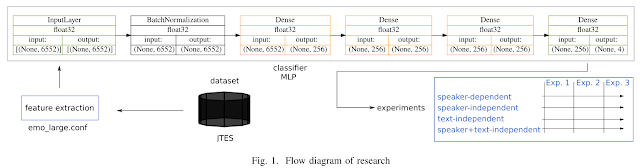
New Paper: Effect of Different Splitting Criteria on Speech Emotion Recognition

Abstract

Traditional speech emotion recognition (SER) evaluations have been performed merely on a speaker-independent (SI) condition; some of them even did not evaluate their result on this condition (speaker-dependent, SD). This paper highlights the importance of splitting training and test data for SER by script, known as sentence-open or text-independent (TI) criteria. The results show that employing sentence-open criteria degraded the performance of SER. This finding implies the difficulties of recognizing emotion from speech in different linguistic information embedded in acoustic information. Surprisingly, text-independent criteria consistently performed worse than speaker+text-independent (STI) criteria. The full order of difficulties for splitting criteria on SER performances from the most difficult to the easiest is text- independent, speaker+text-independent, speaker-independent, and speaker+text-dependent. The gap between speaker+text- independent and text-independent was smaller than other criteria, strengthening the difficulties of recognizing emotion from speech in different sentences.


Method

Experiment #1: average of 30 trials (runs)
Experiment #2: 5-fold cross-validation
Experiment #3: Same number of training and test data


Result


Take home message

Sentence (or linguistic) information plays a crucial role in speech emotion recognition.


Full paper + code:

https://github.com/bagustris/ti

Monday, June 28, 2021

Resources for academic writing: word concordance

When I am writing an academic paper, for a journal, or a conference, I used several tools to find the most precise words. Among these, the following are the most I used ones.
Among those resources, the Mendeley is the most I used since it used the words in my field and can be used offline on my local PC. This technique is also intended to avoid the creation of jargon or our own words. Instead of creating "new words", it is better to follow the words already used by other researchers. Below is my search for the word "splitting" that leads to concord with "into".


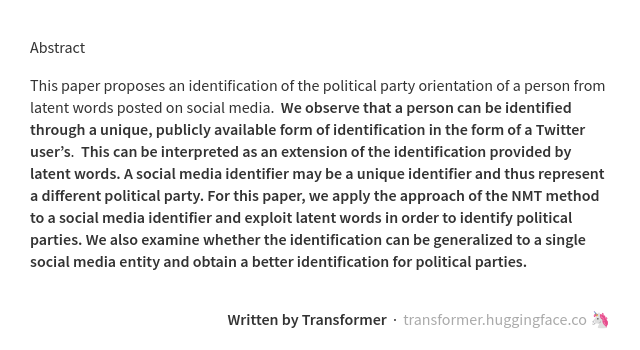
Abstract Generated by Transformer
I tried Huggingface's Transformer once. Instead of generating word concordance, they complete my abstract given only one sentence.


Wednesday, June 09, 2021

Eight Steps to Structuring an Academic Paper

The following tips are my version of "11 steps to structuring a science paper". I revised it from 11 to 8 because of the following reasons.
  1. It makes sense to draft the topic (concretely a title) before starting to structuring the paper.
  2. After drafting a title, it is necessary to draft an abstract along with the keywords to plan what we want to write. These abstract and keywords will guide and give an overview of the overall content of the paper.
  3. I dropped the writing reference. It should be done automatically via BibTeX. Acknowledgment is not necessary unless your research receive funding or important helps from other researchers/agencies.
Here you are.


Note after finishing writing a compelling introduction, you didn't finish your paper yet. You need to revise it many times, mine usually about ten times. In revising, you should follow the order of your paper, from Title to Reference.


Reference: 
 [1] https://www.elsevier.com/connect/11-steps-to-structuring-a-science-paper-editors-will-take-seriously

Friday, February 05, 2021

Book Summary: Grammar Choices for graduate and professional writer

I just realize my mistakes when actually I made a summary but I named it a review (describing the pros and cons of a book). So, from this post, I would like to make summaries of books that I read. 

The summary is especially intended for me, to find faster what I read and remember in the past. In this occasion, I would like to summary a new book provided by my university: Grammar for Graduate and professional writers (2nd ed.) by Nigel Caplan. I resumed this book based on its eight chapters.

This summary only includes important points based on my judgments (and time).

Chapter 1: An approach to academic grammar 

In chapter 1, the author emphasized the ideas inside the books: 
1. Sentence can be broken into slots (clause, subject, verb, complement) 
2. Grammar is more than rules: a range of choices 
3. Your choices create three levels of meaning at the same time: the content of your sentence, your attitude or relationship with the readers, the organization of the text.

At the first concept, the author briefly described clause structure: a finite clause (a complete idea that can stand alone as a complete sentence), subject and verb, limitation of the type of words for each slot, complements (elements that come after and controlled by the verb), and non-finite clauses.

A few common errors on verb complementation include:
  • A small number of reporting words CANNOT be followed by a "that" noun clause. They include support, present, present, discuss, describe, oppose. Thus, the following sentences are wrong.
  • The research supports that the previous finding is true. The data described that the higher resistance, the lower current.
  • The verb "make" and "let" are complemented by a verb in the base form, without "to". It is better to replace "make" to "force", "require", "cause", "lead to", "let" to "allow", "permit", "enable" "facilitate." 
The excerpt of this first chapter is freely available here

Chapter 2: Clause combination

Chapter 2 of this book focuses on equal clause and unequal clause, as an extension of a simple sentence with a finite clause. The difference between an equal clause and an unequal clause is shown below; equal clauses are combined by coordinating conjunctions while unequal clauses are combined by subordinating conjunctions.


Aside from the differences between equal and unequal clauses, the following are the most important takeaways from chapter 2:
  • Punctuating simple, compound, and complex sentences: "and" for any coordinating conjunction, "because" for any subordinating conjunction, and however for any sentence connector.
  • Clauses introduced by "most of", "some of", "two of" are non-restrictive clauses. They need a comma.
  • Three meaning created by clauses: elaborating (e.g., "... ; in fact, ..", ".. and indeed...", ".., which.."; extension (e.g., "Moreover", "..whereas.."); enhancing (e.g., ".., so..", "Although..").
  • Fragments and run-ons are not acceptable in most academic writing, e.g., "Because it is different from the previous " (fragment), "Culture shock is not usual, it happens to almost everyone who moves to a new place" (run-on).

Chapter 3: Embedded, Noun, and Complement Clauses

Embedded clauses are restrictive clauses (that ..., without coma) that restrict the meaning of a noun phrase. 
1a. The students, who had been nervous about their exam results, are waiting for their teacher in that room. (non-restrictive, all students)
1b. The students who had been nervous about their exam results are waiting for their teacher in that room. (restrictive, some students)

Embedded clauses can be reduced. Most cases are "with/that" with "be". See the example below.
Another issue that is to be solved in this paper is the effect of silence regions in speech.

Noun clauses are dependent clause (a clause that cannot stand alone as a complete sentence, e.g., "when he is coming...") that usually complements or reporting linking verbs, nouns or adjective. There are three types of noun clauses:
  1. Subordinator using "that", e.g., "The previous research found that bacteria are present.
  2. Indirect question using "whether", e.g., "Researcher wonder whether the bacteria are present
  3. Indirect question using "where". e.g., "Researchers ask where bacteria are present."
Some exceptions:
  • wonder can be followed by if, whether, any wh-question, but not that.
  • Argue usually followed by that
  • Realizes takes that and what clause but not wh-question, if, or whether.
A complement (noun) clause s a noun clause that is embedded in a noun phrase or used after an adjective. The most commons are claim, argument, fact, e.g., 
The fact that the first simple DNN architecture works is a significant achievement.

Not all nouns can be followed by noun clauses; only nouns that refer to facts, ideas, and opinion can be followed by complement noun clauses. The nouns such as notion, belief, point, principle, evidence, and chance.

Chapter 4 

The focus in chapter 4 is is verb forms. Verbs can be modified in four ways: time, aspects, voice, and modality. The combination of time and aspect is called Tenses, where this unit more focuses on. The summary of Tenses can be shown in the figure below (taken from the book).


Chapter 5

Chapter 5 discusses the noun phrase. One of the most important topics in the noun phrase is whether it needs a determiner, the articles. As I resumed another book: Three Little Words, it is not easy to choose what article needed by a noun phrase. From this book, I obtained additional information that the choice of an article also depends on whether the writer and/or reader know the exact reference of the noun. The following figure shows the resume of the use.


The next chapters talk about Hedging, Boosting, and Positioning (Chapter 6), collocation and corpus searching (Chapter 7), and beyond sentence (Chapter 8). This book, perhaps, is the most complete book explaining grammar and style in academic writing.  It is more complete than free grammar for academic writing or other books. I wish I already read and understand it before pursuing my doctoral degree. But this is not too late.
Related Posts Plugin for WordPress, Blogger...