Showing posts with label paper. Show all posts

Thursday, August 22, 2024

A paper was accepted at ACM MM 2024 Workshop


I am delighted to show that my paper was accepted at the ACM MM 2024. This was my first ACM paper and was written by myself solely (solo author). Here is an abstract from the screenshot of the paper above.

Abstract

 Automatic social perception recognition is a new task to mimic the measurement of human traits, which was previously done by humans via questionnaires. We evaluated unimodal and multimodal systems to predict agentive and communal traits from the LMU-ELP dataset. We optimized variants of recurrent neural networks from each feature from audio and video data and then fused them to predict the traits. Results on the development set show a consistent trend that multimodal fusion outperforms unimodal systems. The performance-weighted fusion also consistently outperforms mean and maximum fusions. We found two important factors that influence the performance of performance-weighted fusion. These factors are normalization and the number of models.

Once the link to the paper is available in the ACM Library, I will put the link here.

Link: https://dl.acm.org/doi/10.1145/3689062.3689082.

Behind The Scene and Tips!

I have participated in the MuSe challenge (Multimodal Sentiment Analysis Challenge and Workshop) for several years. This challenge, along with other challenges in conferences like ICASSP and Interspeech, usually provides ba aseline program (code) and the respected dataset (e.g., ComParE). From this baseline, we can further analyze, make experiments, and often get new ideas to implement. My idea for that challenge (social perception challenge) is two parts: parameter optimization and multimodal fusion. I implement a lot of ideas (e.g., tuning more than 15 parameters) and some works. Once I get improvement with consistent results/phenomena (science must be consistent!), I documented my work and submitted a paper. This time, my paper got accepted!

See you in Melbourne, inshallah!

Tuesday, January 04, 2022

New Paper: Effect of Different Splitting Criteria on Speech Emotion Recognition

Abstract

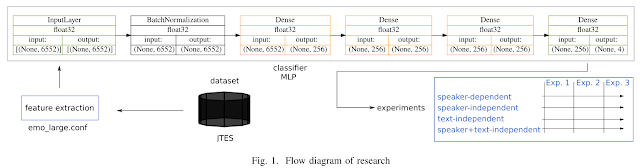
Traditional speech emotion recognition (SER) evaluations have been performed merely on a speaker-independent (SI) condition; some of them even did not evaluate their result on this condition (speaker-dependent, SD). This paper highlights the importance of splitting training and test data for SER by script, known as sentence-open or text-independent (TI) criteria. The results show that employing sentence-open criteria degraded the performance of SER. This finding implies the difficulties of recognizing emotion from speech in different linguistic information embedded in acoustic information. Surprisingly, text-independent criteria consistently performed worse than speaker+text-independent (STI) criteria. The full order of difficulties for splitting criteria on SER performances from the most difficult to the easiest is text- independent, speaker+text-independent, speaker-independent, and speaker+text-dependent. The gap between speaker+text- independent and text-independent was smaller than other criteria, strengthening the difficulties of recognizing emotion from speech in different sentences.


Method

Experiment #1: average of 30 trials (runs)
Experiment #2: 5-fold cross-validation
Experiment #3: Same number of training and test data


Result


Take home message

Sentence (or linguistic) information plays a crucial role in speech emotion recognition.


Full paper + code:

https://github.com/bagustris/ti

Monday, June 28, 2021

Resources for academic writing: word concordance

When I am writing an academic paper, for a journal, or a conference, I used several tools to find the most precise words. Among these, the following are the most I used ones.
Among those resources, the Mendeley is the most I used since it used the words in my field and can be used offline on my local PC. This technique is also intended to avoid the creation of jargon or our own words. Instead of creating "new words", it is better to follow the words already used by other researchers. Below is my search for the word "splitting" that leads to concord with "into".


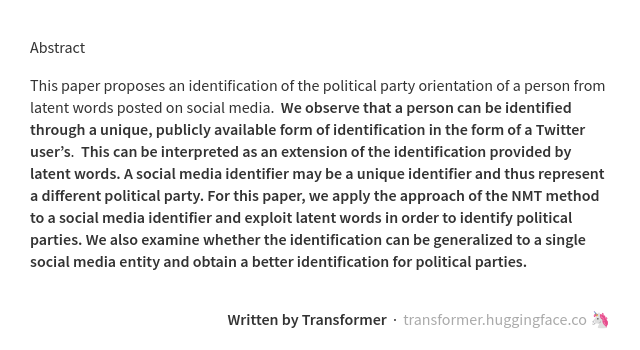
Abstract Generated by Transformer
I tried Huggingface's Transformer once. Instead of generating word concordance, they complete my abstract given only one sentence.


Wednesday, June 09, 2021

Eight Steps to Structuring an Academic Paper

The following tips are my version of "11 steps to structuring a science paper". I revised it from 11 to 8 because of the following reasons.
  1. It makes sense to draft the topic (concretely a title) before starting to structuring the paper.
  2. After drafting a title, it is necessary to draft an abstract along with the keywords to plan what we want to write. These abstract and keywords will guide and give an overview of the overall content of the paper.
  3. I dropped the writing reference. It should be done automatically via BibTeX. Acknowledgment is not necessary unless your research receive funding or important helps from other researchers/agencies.
Here you are.


Note after finishing writing a compelling introduction, you didn't finish your paper yet. You need to revise it many times, mine usually about ten times. In revising, you should follow the order of your paper, from Title to Reference.


Reference: 
 [1] https://www.elsevier.com/connect/11-steps-to-structuring-a-science-paper-editors-will-take-seriously

Monday, November 09, 2020

Dibalik Setiap Penolakan Pasti Ada Hikmah!

Tulisan ini bukan berkaitan dengan percintaan (meski bisa juga dihubungkan dan masuk juga), tapi tentang pengalaman saya menulis paper (makalah ilmiah). Setidaknya saya pernah beberapa kali ditolak, tapi justru mendapat ganti yang lebih besar dari penolakan itu. Berikut beberapa contohnya.

1. Ditolak di AVEC 2019 malah diterima di ICASSP 2020

Bagi anda yang bergelut di bidang pengolahan sinyal (signal processing), ICASSP adalah konferensi kasta tertinggi yang hanya bisa dilampaui oleh jurnal berindeks Q1. Pun demikian bagi saya. Setelah dua tahun berturut-turut ditolak di ICASSP 2020, akhirnya pada usaha ketiga di tahun 2020 paper saya diterima. Saya belajar dari hasil review tahun sebelumnya (importance/relevance, novelty, technical correctness, experimental validation, clarity, reference). Awalnya paper yang saya buat saya targetkan untuk dimasukkan di AVEC 2019. Setelah ditolak di AVEC 2019, paper tersebut saya revisi berdasarkan komentar dari reviewer AVEC 2019.  Diterima di ICASSP merupakan salah satu pencapaian terbesar dalam karir saya. Dan juga mungkin pertama dan terakhir kalinya saya ikut ICASSP karena biaya registrasinya yang sangat besar (USD 800).

2. Ditolak di INTERSPEECH 2020, mendapat best paper award di OCOCOSDA 2020

Bagi anda yang bergelut di bidang sains dan teknologi sinyal wicara, diterima di INTERSPEECH adalah impian, karena konferensi tsb setara dengan ICASSP khusus untuk bidang pengolahan sinyal wicara. Sampai tulisan ini ditulis, saya belum pernah bisa menembus (baca: diterima) di INTERSPEECH. Di tahun 2020 ini (usaha kedua saya selama berturut-turut) saya kembali ditolak di INTERSPEECH. Paper yang sama saya masukkan di OCOCOSDA dan diterima (ketiga reviewer semua menerimanya). Bahkan paper saya mendapat anugerah "best (student) paper award". Alhamdulillah dan mendapatkan insentif sejumlah biaya pendaftaran.


Dari penolakan-penolakan tersebut saya belajar: pasti kita akan mendapat ganti yang lebih baik asal kita sabar dan terus berusaha. Inilah salah satu hikmahnya. Dan penolakan-ganti tersebut akan terus ada, baik ketika ditolak di perusahaan (gaji) kecil malah diterima di perusahaan (gaji) besar atau ditolak si A malah mendapatkan si B!

Wednesday, July 08, 2015

Tutorial Latex Sederhana dan Instalasinya

Bisa menggunakan Latex adalah salah satu skill dasar yang harus dimiliki oleh mereka yang ingin menjadi ilmuwan atau peneliti (scientist and researcher). Menguasai Latex akan memudahkan kita ketika menulis paper akademik dan saintifik semisal jurnal, conference paper dan thesis (TA dan disertasi).

Untuk dapat menggunakan Latex, anda harus menginstallnya terlebih dahulu. Jika anda memakai Windows, anda bisa mengintall miktex dan texworks. Untuk Unix, khususnya Linux, saya akan mendemokan instalasi Latex dengan editor Gedit.

Step-by-step instalasi Latex dan gedit-latex-plugin (di terminal) di Ubuntu (14.04):
    1. sudo apt-get install latex
    2. sudo apt-get install gedit-latex-plugin
Dengan dua perintah tersebut (bisa dijadikan satu juga), maka Ubuntu anda sudah terinstall Latex, lebih sederhana dibandingkan dengan instalasi pada Windows. Silakan cek pada gedit, aktifkan plugin, edit >> preference >> plugin, synctex. Kemudian akan muncul tab "Latex" serta menu "Tools" Latex--> pdf, pada window Gedit anda.

Tampilan Gedit dengan plugin Latex
Selanjutnya, anda dapat mendownload tutorial Latex di bawah ini untuk belajar Latex, file sumber saya sertakan disini.